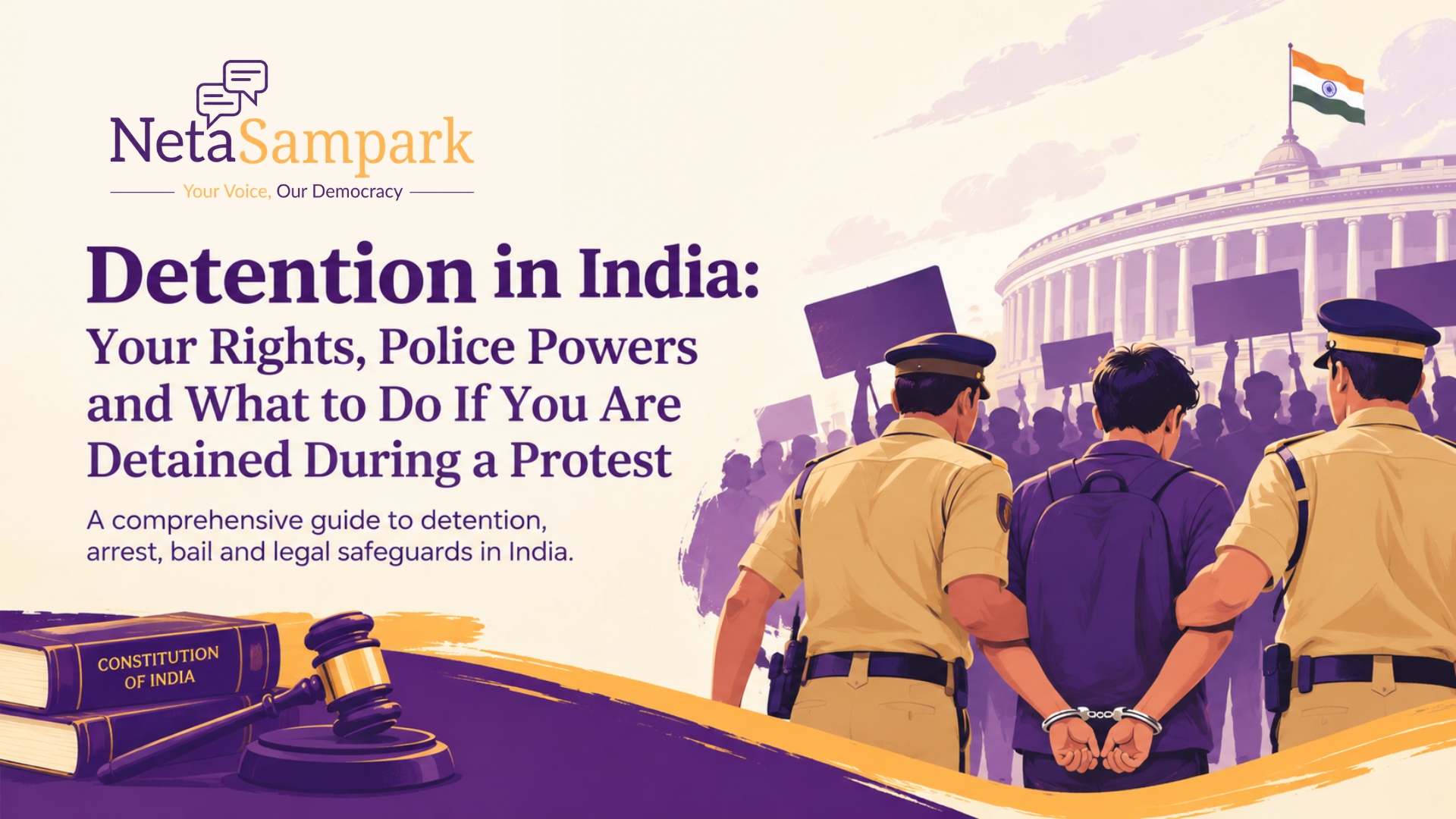
A comprehensive citizen’s guide to detention, arrest, police custody, bail, constitutional safeguards and legal assistance in India.
When people gather to protest, participate in a march or raise their voices on a public issue, they may encounter police action. Some people may be asked to disperse, others may be taken to a police station, and some may be formally arrested.
These situations can be confusing, particularly when someone does not know why they are being taken away, where they are being held or how to contact their family.
What exactly does detention mean? Is it the same as arrest? Can the police take someone away from a peaceful protest? What rights does an arrested person have? Can someone be held for more than 24 hours? And what should family members do if they cannot locate a person who was taken by the police?
Understanding these questions is important for every citizen.
The Constitution of India protects personal liberty and establishes safeguards against unlawful arrest and detention. At the same time, the police have legal powers to prevent offences, investigate alleged crimes and maintain public order. These powers must be exercised within the law.
This guide explains the basics of detention in India, the relevant legal framework, the rights of people taken into custody and the practical steps individuals and their families can take.
Important: This article provides general legal information for public awareness. It is not a substitute for advice from a qualified lawyer about a specific situation.
1. What Is Detention?
In simple terms, detention means restricting a person's freedom to leave a place or situation.
The word is often used broadly in everyday conversation. For example, when the police take protesters away from a demonstration, news reports may describe them as having been “detained”.
However, the word alone does not establish the exact legal status of the person.
Depending on the circumstances, the police action might involve a temporary restriction on movement, a preventive power, a formal arrest or detention under a specific law. Each situation may have different legal requirements and safeguards.
If someone is taken away by the police, some of the most important questions are:
* Why has the person been stopped or taken away?
* What legal power is the police relying on?
* Has the person been formally arrested?
* Where are they being taken?
* Are they free to leave?
* What procedure and safeguards apply to their situation?
The legal basis of the action matters more than the label used to describe it. Calling an action “detention” does not automatically make it lawful, and calling it “arrest” does not establish that the arrest was lawful.
2. Detention vs Arrest vs Police Custody
These terms are related, but they do not mean the same thing.
Detention :Detention is a broad term for restricting a person's liberty. It can arise in different legal contexts, including certain preventive actions. The legal basis, procedure and duration depend on the power being exercised.
Arrest : Arrest is a formal exercise of legal authority to take a person into custody. Depending on the circumstances and the law, an arrest may be made with or without a warrant.
An arrest does not mean that the person has been convicted of an offence. The allegations must still be dealt with through the appropriate legal process.
Police custody : Police custody refers to a situation in which a person is held in police custody. Following an arrest, a magistrate may authorise police custody for investigation, subject to the applicable law.
Judicial custody : Judicial custody generally means that a person is held under the authority of a court, commonly in a jail or other authorised facility, rather than being held in police custody for interrogation.
Preventive detention : Preventive detention is a distinct legal category in which a person may be detained to prevent anticipated conduct in circumstances specified by law. It is governed by a separate constitutional framework and applicable legislation.
Preventive detention should not be confused with an ordinary arrest or a brief police action during a protest.
Why does this distinction matter?
The rights, time limits, procedures and remedies available to a person depend in part on the legal basis for restricting their liberty.
3. Can the Police Detain People During a Protest?
The police have responsibilities to maintain public order, prevent offences and respond to situations that may threaten public safety.
Depending on the circumstances and the applicable law, police may:
* Direct a gathering to disperse.
* Enforce a valid order regulating an assembly.
* Take preventive action where the legal conditions are met.
* Remove people from a location under lawful authority.
* Arrest a person suspected of committing an offence when the legal requirements for arrest are satisfied.
The Bharatiya Nagarik Suraksha Sanhita, 2023 (BNSS), which came into force on , contains important provisions governing criminal procedure and police powers.
Three provisions are particularly relevant to understanding police action and custody:
* Section 35: Addresses circumstances in which police may arrest without a warrant and when a notice to appear may be used instead of arrest.
* Section 163: Concerns urgent orders in cases of nuisance or apprehended danger, subject to the statutory conditions.
* Section 172: Addresses the duty to conform to lawful directions of police in specified circumstances and the consequences of resisting, refusing or disregarding such directions.
These provisions do not give the police an unlimited power to restrict people's liberty. The relevant legal conditions, the facts of the situation and the required procedural safeguards must be considered.
Official legal reference: Bharatiya Nagarik Suraksha Sanhita, 2023 — India Code.
A peaceful protest is not automatically unlawful because it criticises the government or expresses opposition to a public policy. At the same time, the right to protest does not exempt participants from valid laws governing public order, violence, obstruction or other offences.
The central question is whether the action taken by the authorities is supported by law and carried out according to the applicable procedure.
4. What Is Section 163 of the BNSS? Can It Be Used Against Peaceful Protests?
Section 163 of the BNSS, 2023, carries forward the provision previously found in Section 144 of the Code of Criminal Procedure, 1973.
It empowers an authorised magistrate to issue written orders in urgent cases of nuisance or apprehended danger where the statutory conditions are met.
The provision addresses circumstances involving matters such as:
* Obstruction, annoyance or injury to a person lawfully employed.
* Danger to human life, health or safety.
* A disturbance of public tranquillity.
* A riot or affray.
The provision has specific legal requirements concerning the circumstances in which an order may be made. The nature and terms of the actual order therefore matter.
Is Section 163 a blanket ban on protests?
No. Section 163 is not a blanket ban on peaceful protest.
A Section 163 order should not be treated as an automatic declaration that every peaceful gathering is unlawful. Its legality depends on the statutory requirements, the circumstances, the terms of the order and the applicable constitutional safeguards.
At the same time, peaceful intentions alone do not automatically invalidate an order that has been lawfully issued.
If a protest is affected by a Section 163 order, citizens should check the actual order and seek legal advice rather than relying only on a news headline or a social media claim.
The existence of an order, the restrictions it imposes and the legal basis for any subsequent police action should be assessed on their facts.
5. Is Detention During a Peaceful Protest Always Illegal?
No. It would be inaccurate to say that every detention during a peaceful protest is illegal. It would also be inaccurate to assume that every police action is automatically lawful.
The circumstances must be examined.
Relevant questions may include:
* Was there a lawful order or another legal basis for the action?
* Was the person suspected of a specific offence, or was a valid preventive power being exercised?
* Were the legal conditions for arrest or detention satisfied?
* Were the applicable constitutional and statutory safeguards followed?
* Was the person informed of the relevant grounds where required?
* Was the person released, produced before the appropriate authority or dealt with according to the applicable procedure?
The fact that someone participated in a protest does not, by itself, establish that they committed an offence.
Similarly, the claim that a person was peacefully protesting does not, on its own, resolve every legal question about the police action.
If someone believes their liberty has been unlawfully restricted, they should seek advice from a lawyer or an appropriate legal services authority.
6. What Does the Constitution Say About Arrest and Detention?
The Constitution of India establishes important protections for personal liberty.
Article 21: Protection of life and personal liberty
Article 21 states that no person shall be deprived of life or personal liberty except according to procedure established by law.
This protection applies to people accused of offences as well as other individuals. A person does not lose their constitutional protections simply because they have been arrested.
Article 22: Safeguards against arrest and detention
Article 22 establishes important safeguards for arrested persons, including protections concerning communication of the grounds of arrest, access to legal counsel and production before a magistrate within the constitutionally prescribed period.
Article 22 also treats preventive detention separately. Its safeguards for ordinary arrest do not apply in precisely the same way to every category of detention.
Article 19: Freedom of speech and peaceful assembly
Article 19(1)(a) protects freedom of speech and expression.
Article 19(1)(b) protects the right to assemble peacefully and without arms.
These freedoms are subject to the constitutional restrictions permitted under Articles 19(2) and 19(3), respectively.
The right to protest is an important part of democratic participation. However, it does not create an unrestricted right to occupy every location, disregard every lawful direction or engage in violence.
Together, these constitutional provisions aim to protect liberty while allowing authorities to address genuine public-safety and criminal-justice concerns within the law.
7. What Are Your Rights If You Are Arrested?
If the police formally arrest you, several safeguards become especially important.
1. You should be informed of the grounds of arrest
Article 22(1) requires that an arrested person be informed, as soon as may be, of the grounds of arrest, subject to the constitutional framework and applicable law.
The BNSS also contains requirements concerning communication of the grounds of arrest and information about bail in applicable cases.
If you do not understand the reason given, calmly ask for clarification. When it is safe to do so, record the information as accurately as possible.
2. You have the right to consult a lawyer
Article 22(1) protects the right of an arrested person to consult and be defended by a legal practitioner of their choice.
Section 38 of the BNSS provides for an arrested person to meet an advocate of their choice during interrogation, though not throughout the interrogation.
If you cannot afford a lawyer, you may qualify for free legal services under the applicable legal aid framework.
3. Your family or another nominated person should be informed
The BNSS contains safeguards concerning information about an arrest and the place where the arrested person is being held. The applicable procedure includes informing a relative, friend or other nominated person as required by law.
Ask that the appropriate person be informed.
If you are a family member trying to locate someone, provide the police with the person's full name, age, contact details and the time and location where they were last seen.
4. You must be produced before a magistrate within the applicable time limit
Article 22(2) of the Constitution generally requires a person who is arrested and detained in custody to be produced before the nearest magistrate within 24 hours of arrest, excluding the time necessary for the journey from the place of arrest to the court.
The BNSS contains related procedural safeguards:
* Section 57 addresses taking or sending a person arrested without a warrant before the appropriate magistrate or police station officer without unnecessary delay, subject to the applicable provisions on bail.
* Section 58 generally prohibits detention in police custody beyond 24 hours without a special order of a magistrate under Section 187, excluding the necessary journey time.
* Section 187 governs the procedure when an investigation cannot be completed within the initial 24-hour period and further detention is sought.
Important: The 24-hour rule is not a universal release deadline. It generally requires production before a magistrate within the applicable period. Further detention may be authorised when the legal requirements are met. Different procedures may apply under preventive-detention provisions and certain special laws.
If someone has been taken into custody and their whereabouts or legal status is unclear, seek prompt legal assistance.
5. You must be treated with regard for your health and safety
Section 56 of the BNSS places a duty on the person having custody of an accused to take reasonable care of their health and safety.
If you are injured, require urgent medical attention, need prescribed medication or require disability-related assistance, communicate that need clearly and ask that it be recorded.
Your family or lawyer should raise concerns about injury or denial of necessary medical care promptly.
6. You cannot be compelled to incriminate yourself
Article 20(3) protects an accused person against being compelled to be a witness against themselves.
The precise application of this protection depends on the circumstances. It does not mean that every question asked during a lawful investigation can simply be ignored.
If you are unsure about a question or statement, request legal advice before signing or making a statement that may have legal consequences.
These safeguards are part of the legal framework governing arrest and custody. Their exact application depends on the facts and relevant law.
8. Can the Police Arrest Someone Without a Warrant?
Yes. The police can arrest without a warrant in circumstances authorised by law. A warrant is not required for every arrest.
Section 35 of the BNSS sets out circumstances in which the police may arrest without a warrant. For specified offences punishable with imprisonment of up to seven years, the provision includes conditions concerning the officer's reasons for believing that the person committed the offence and the necessity of arrest.
The provision also addresses circumstances in which a notice to appear should be issued instead of arrest.
This means the police do not have an unrestricted power to arrest anyone they choose. The statutory conditions and safeguards must be considered.
If a person receives a notice to appear at a police station, they should not automatically assume that it is the same as an arrest. They should read the document carefully, confirm the issuing authority and seek legal advice about their obligations.
9. What Happens After an Arrest?
The process depends on the alleged offence, the applicable law and the facts of the case. In a typical criminal-procedure context, the following steps may occur.
Step 1: The arrest is made.
The police exercise a legal power of arrest and follow the applicable procedure.
Step 2: The grounds and required information are communicated.
The arrested person should receive the information and safeguards required by law.
Step 3: The person is taken to the appropriate police station or authority.
The arrest and related information must be handled according to the applicable legal requirements.
Step 4: Bail is considered where available.
Depending on the offence and legal framework, release on bail or bond may be possible. Bail is not automatic in every case.
Step 5: The person is produced before a magistrate when required.
The court considers the circumstances of custody and whether further detention is authorised under the applicable law.
Step 6: The investigation and court proceedings continue.
The person may be released, remain in authorised custody or be subject to other lawful directions.
Being arrested does not establish guilt. A person's criminal liability must be determined through the appropriate legal process.
10. What Is the Difference Between Bailable and Non-Bailable Offences?
The classification of an offence affects the process for obtaining release from custody.
Bailable offences
In a bailable offence, bail is generally a matter of right when the applicable statutory conditions are met.
Non-bailable offences
In a non-bailable offence, bail is not automatically available as a right under the ordinary classification. The court or other authorised authority considers the application under the applicable law.
Non-bailable does not mean “no bail”. Bail may still be granted, depending on the facts, the law and the decision of the competent authority.
The classification of an offence should be checked against the relevant statute and schedule. A person should not rely only on a social media post, a news headline or an informal description of the allegation.
11. Can Someone Be Detained Without Being Formally Arrested?
Police action may sometimes involve a temporary restriction on a person's movement without the situation being described as a formal arrest.
However, the word “detention” does not create an independent, unlimited power to hold someone. The police must rely on an applicable legal basis, and the safeguards and time limits depend on that basis.
The BNSS includes specific provisions concerning police directions and preventive action. Other laws may apply in particular circumstances.
If someone is taken away from a protest, family members should try to establish:
* Whether the person is formally arrested or being held under another power.
* The name of the police station or authority holding them.
* The legal provision or reason given for the action.
* Whether an arrest memo, notice, FIR or other document exists, where applicable.
* Whether and when the person will be brought before a magistrate or released.
If the authorities will not provide clear information or the person cannot be located, seek assistance from a lawyer and the relevant District Legal Services Authority.
12. What Should You Do If You Are Detained During a Protest?
A stressful situation can make it difficult to remember what to do. These practical steps may help.
Stay calm and prioritise safety
Avoid physical resistance, threats or actions that could increase the risk of injury. If you disagree with the police action, that disagreement can be raised through appropriate legal channels.
Remaining calm does not mean giving up your legal rights.
Ask why you are being taken away
Where it is safe to do so, ask whether you are being detained or formally arrested and what legal basis is being relied upon.
Listen carefully to the response. Do not assume that the terminology used by an officer settles the legal question.
Request that someone be informed
Ask the police to inform a family member, friend or nominated person in accordance with the applicable safeguards. If possible, remember or communicate the police station or destination.
Request legal assistance
Ask to contact your lawyer or access legal aid. If you do not have a lawyer, a District Legal Services Authority or the relevant legal services institution can help you understand your options.
Communicate urgent medical needs
If you are injured, unwell, need prescribed medication or require disability-related assistance, clearly communicate that need and request medical care.
Do not sign documents you do not understand
Ask for an explanation of any document before signing it. If you are unsure of its meaning or legal effect, request advice from a lawyer.
Do not make false statements or destroy evidence.
Preserve relevant information when safe and lawful
If you can do so safely, note the time, location, names or identifying details of officials, witnesses and relevant events.
If you believe your rights were violated, this information may help a lawyer assess the situation.
Do not put yourself or others in danger to obtain a recording or photograph.
13. What Should Family Members Do If Someone Is Detained?
Family members may not immediately know where a person has been taken. A clear, organised response can help.
Step 1: Confirm the basic details
Record the person's full name, age, phone number, last known location, approximate time they were taken and any witnesses who saw the incident.
Step 2: Contact the relevant police station
Ask whether the person is there, whether they have been formally arrested and which officer or unit is handling the matter.
If you do not know the station, contact the relevant local police authorities and provide the last known location.
Step 3: Ask about the legal basis and documentation
Where applicable, seek information about the arrest, the alleged offence, relevant case or FIR details and the place where the person is being held.
Step 4: Contact a lawyer
A lawyer can help locate the person, assess the legality of the action, advise on bail and represent the person in court.
Step 5: Contact legal aid if needed
The National Legal Services Authority (NALSA) provides information about free legal services. People in custody are among the categories recognised under the Legal Services Authorities Act, 1987.
The national legal aid helpline is 15100. Families can also approach the relevant State Legal Services Authority or District Legal Services Authority.
Step 6: Act urgently if the person cannot be located or may be at risk
A lawyer can advise whether to approach the appropriate court or seek another legal remedy. Do not assume that waiting is necessary simply because the family does not have complete information.
Keep a written record of calls, dates, names, reference numbers and responses. Share verified information with the lawyer rather than relying on rumours or unconfirmed online posts.
14. What Special Safeguards Apply to Women and Children?
Certain protections and procedures are especially important where women or children are involved.
Women
The BNSS contains specific provisions concerning the arrest of women, including restrictions on arrest after sunset and before sunrise, subject to exceptional circumstances and the required authorisation. Other safeguards govern searches and interactions with women in custody.
The precise procedure depends on the circumstances and applicable law. A woman who has been arrested should be able to seek legal assistance and medical care where required.
Children
A person under 18 who is alleged to have committed an offence is dealt with under the juvenile justice framework, including the Juvenile Justice (Care and Protection of Children) Act, 2015, rather than simply being treated as an adult accused.
Children have specific safeguards concerning apprehension, production before the relevant authority, care, protection and legal assistance.
If a child is taken into custody in connection with a protest or another incident, a lawyer experienced in juvenile justice should be contacted promptly.
Where a person has a disability, serious medical condition or communication support needs, these should be brought to the attention of the authorities and legal representative as soon as possible.
15. What If You Believe the Detention Was Unlawful?
A person who believes their detention or arrest was unlawful can seek legal advice about available remedies.
Depending on the facts, the options may include:
* Applying for bail, where available.
* Raising procedural or constitutional violations before the appropriate court.
* Seeking judicial review of unlawful restraint, including through a habeas corpus petition in a suitable case.
* Making a complaint to the appropriate police oversight or human rights body, where appropriate.
* Preserving evidence and seeking other remedies that a lawyer considers legally available.
A habeas corpus petition is a legal remedy through which a court may be asked to examine whether a person's detention or restraint is lawful.
The correct remedy depends on the nature of the action, the legal provision involved, the stage of proceedings and the evidence available.
It is important not to assume that every procedural irregularity automatically results in release or compensation. A lawyer can assess the legal consequences of the particular facts.
16. Important Supreme Court Principles on Arrest and Custody
Indian courts have repeatedly emphasised that personal liberty must be protected and that police powers are subject to legal safeguards.
D.K. Basu v. State of West Bengal (1997)
In D.K. Basu v. State of West Bengal, the Supreme Court laid down safeguards relating to arrest and detention. These included requirements intended to improve transparency and accountability and reduce the risk of custodial abuse.
The judgment remains an important reference point for understanding procedural protections for people taken into custody.
Personal liberty and dignity in custody
The Supreme Court has emphasised that constitutional protections do not disappear when a person is arrested. The state remains responsible for respecting a person's life, dignity and legal rights while they are in custody.
What do these principles mean for citizens?
The existence of police powers does not remove the requirement to follow the law.
Equally, a claim that someone has been detained unlawfully should be assessed using evidence and the relevant legal provisions rather than assumptions.
The legal framework aims to balance the state's responsibility to maintain public order with each person's right to liberty and due process.
17. Common Myths About Detention in India
Myth 1: If someone is detained, they must have committed a crime.
Fact: Detention or arrest is not a conviction. The legal basis and circumstances must be examined, and guilt must be determined through the appropriate process.
Myth 2: Every detention is illegal if the person was protesting peacefully.
Fact: Peaceful assembly is constitutionally protected, but specific lawful restrictions and police powers may apply. The circumstances determine whether the action was lawful.
Myth 3: Police always need an arrest warrant.
Fact: The law permits arrests without a warrant in specified circumstances.
Myth 4: Every person described as detained must be released within 24 hours.
Fact: The constitutional 24-hour rule generally concerns production before a magistrate following arrest, excluding necessary journey time. It is not a universal release deadline, and further detention may be authorised according to law.
Myth 5: Non-bailable offences never permit bail.
Fact: Bail may still be granted in non-bailable cases, subject to the applicable law and the decision of the competent authority.
Myth 6: A person loses their rights after arrest.
Fact: People in custody continue to have constitutional and statutory protections, including safeguards concerning personal liberty, legal assistance and health and safety.
Myth 7: Section 163 automatically makes every gathering unlawful.
Fact: Section 163 provides for urgent orders when statutory conditions are met. The actual order, its legal basis and the circumstances must be considered.
18. Where Can You Seek Legal Help?
If you or someone you know has been detained or arrested, consider contacting:
* A qualified criminal-law lawyer: For advice specific to the facts and applicable law.
* National Legal Services Authority (NALSA): For information about free legal services and the legal aid system.
* State Legal Services Authority or District Legal Services Authority: For local legal aid and assistance.
* NALSA helpline: 15100: For legal assistance and guidance.
* The appropriate court: Through a lawyer, if judicial intervention is needed.
Official resource: National Legal Services Authority — FAQs and legal aid information.
Free legal aid is available to eligible categories under the Legal Services Authorities Act, 1987. These include women, children, members of Scheduled Castes and Scheduled Tribes, persons in custody and other qualifying categories. Eligibility and procedures should be confirmed with the relevant legal services institution.
19. Frequently Asked Questions About Detention in India
Is detention the same as arrest in India?
No. Detention is a broad term for restricting someone's liberty, while arrest is a formal legal action that triggers specific procedures and safeguards. The legal nature of an incident depends on what actually happened and the power exercised.
Can police take someone away from a protest?
Police may take action under applicable laws in certain circumstances, including to prevent offences or maintain public order. Whether a particular action is lawful depends on its legal basis, the circumstances and compliance with the required safeguards.
Do police have to tell an arrested person why they are being arrested?
Article 22(1) protects the right of an arrested person to be informed of the grounds of arrest, subject to the constitutional framework and applicable law. The BNSS also contains requirements governing communication of those grounds.
Can an arrested person contact a lawyer?
An arrested person has the constitutional right to consult and be defended by a legal practitioner of their choice. Section 38 of the BNSS also provides for meeting an advocate during interrogation, though not throughout the interrogation.
Can a person be kept in custody for more than 24 hours?
Article 22(2) of the Constitution generally requires an arrested person to be produced before the nearest magistrate within 24 hours, excluding necessary journey time.
Under the BNSS, Sections 57 and 58 address prompt production of a person arrested without a warrant and the general 24-hour limit on detention without a magistrate's special order. Section 187 governs the procedure for seeking further detention when an investigation cannot be completed within that period.
The rule does not mean that release is automatic at the end of 24 hours. Continued detention must be authorised and handled according to the applicable law. Preventive detention and certain special laws may involve different procedures.
What should I do if my family member has disappeared after being taken by police?
Record the last known location and time, contact the relevant police authorities, seek information about the person's whereabouts and legal status, and contact a lawyer or legal aid authority urgently. If the person cannot be located or their liberty may be unlawfully restricted, a lawyer can advise on appropriate court remedies.
Does being arrested mean a person is guilty?
No. Arrest is not a finding of guilt. The allegations must be dealt with through the applicable legal process.
Can someone be detained under Section 163 simply for criticising the government?
Criticism of the government is protected by constitutional freedom of speech, subject to applicable restrictions. Section 163 concerns urgent orders in cases of nuisance or apprehended danger and requires its statutory conditions to be met. Whether a particular order or police action is lawful depends on the facts, the order and the applicable law.
Conclusion: Know Your Rights. Understand the Law.
Detention and arrest can be frightening experiences, particularly when they occur during a public demonstration. Understanding the law helps citizens respond calmly, identify the safeguards that may apply and seek help when necessary.
The Constitution protects personal liberty, while the law also gives authorities powers to prevent offences and maintain public order. Both must operate within the law.
If you or someone you know is detained:
* Establish the person's whereabouts and legal status.
* Ask for information about the legal basis of the action where it is safe to do so.
* Seek appropriate legal assistance.
* Preserve relevant information.
* Avoid relying on rumours or assuming that every situation follows the same procedure.
An informed citizen is better equipped to understand their rights, protect their liberty and respect the rights of others.
Neta Sampark — Your Voice, Our Democracy.
Disclaimer: This article is intended for general public awareness and educational purposes. It does not constitute legal advice and should not be relied upon as a substitute for advice from a qualified lawyer. Laws, procedures and court interpretations may change. Always verify the applicable law and seek advice based on the specific facts of your situation.
Official references to include
D.K. Basu v. State of West Bengal (1997), Supreme Court of India — safeguards relating to arrest and detention.