How Does the Indian Government Work? A Simple Guide to India's Government
India is the world's largest democracy, with a system of government designed to represent its citizens, make laws, implement policies and protect constitutional rights. But how does the Indian government actually work? What is the difference between the President and the Prime Minister? Who makes laws, who implements them, and what role do state governments and local authorities play?
Understanding how the Indian government works helps citizens make sense of public policies, elections, government schemes and the responsibilities of their elected representatives.
This guide explains the structure of the Indian government, the three organs of government, the roles of key institutions, how laws are made and how citizens can participate in democracy.
Quick Answer: How Does the Indian Government Work?
India operates under a parliamentary democratic system established by the Constitution of India. Government authority is exercised through constitutional institutions at the Union, state and local levels.
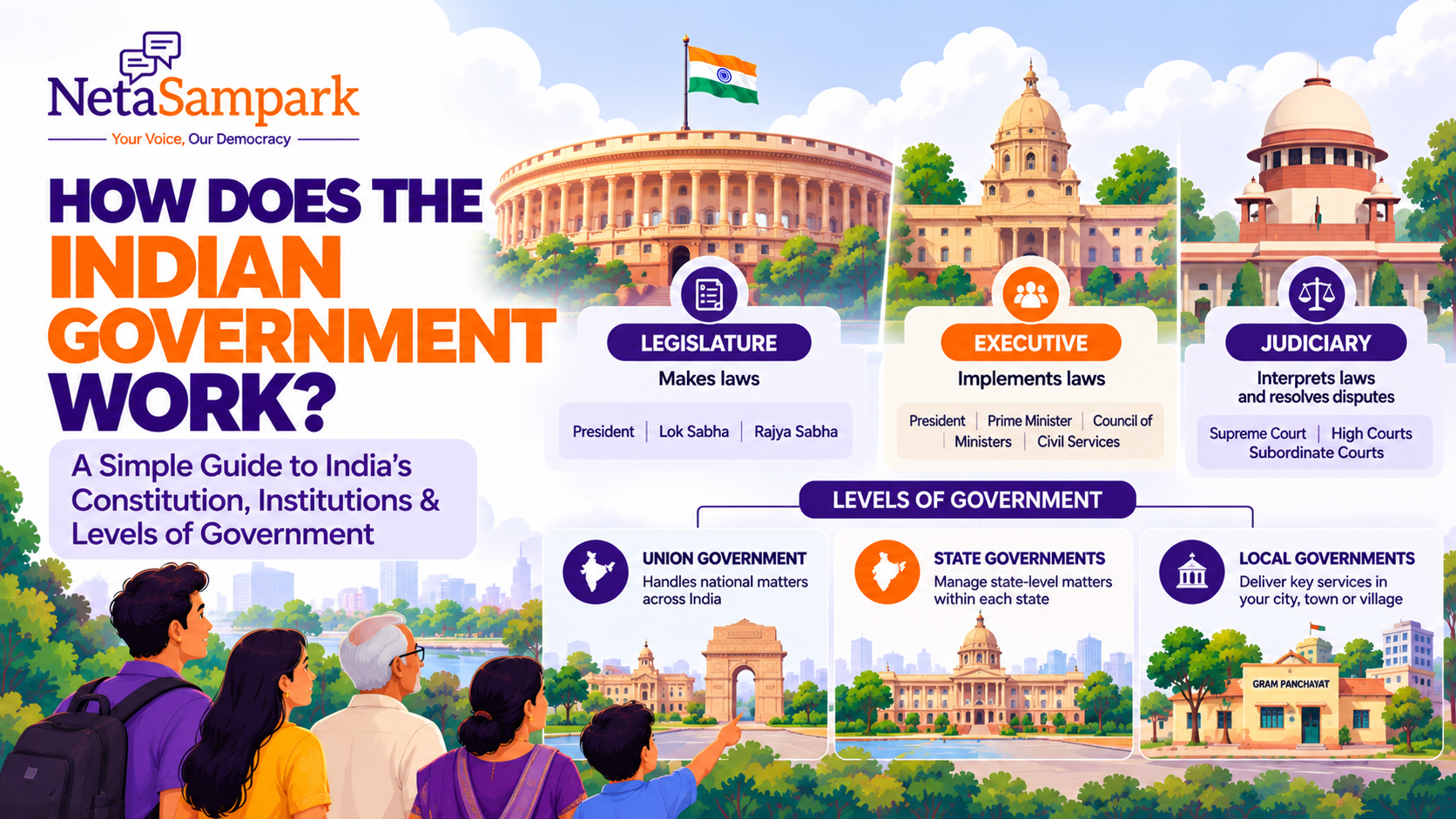
The system has three main organs:
- Legislature: Makes laws, debates public issues and holds the government accountable.
- Executive: Implements laws, administers government departments and delivers public services.
- Judiciary: Interprets laws, resolves disputes and protects constitutional rights.
At the national level, Parliament consists of the President, the Lok Sabha and the Rajya Sabha. The Prime Minister and Council of Ministers lead the Union government's day-to-day administration. State governments manage matters within their constitutional responsibilities, while local bodies address community-level needs.
The Constitution defines the powers of these institutions and establishes checks and balances to prevent the misuse of government authority.
1. What Is the Constitution of India?
The Constitution of India is the country's supreme legal framework. It establishes the structure of government, defines the powers of public institutions and sets out the rights and duties associated with citizenship.
The Constitution was adopted by the Constituent Assembly on and came into effect on , when India became a republic.
It establishes India as a sovereign, socialist, secular, democratic republic and provides for a parliamentary form of government.
The Constitution serves several important purposes:
- Defines the powers and responsibilities of the Union and state governments.
- Establishes Parliament, state legislatures and the executive.
- Provides for an independent judiciary.
- Protects Fundamental Rights.
- Establishes the framework for elections and representative democracy.
- Sets out procedures for making laws and amending the Constitution.
Government institutions cannot exercise unlimited power. Their authority must remain within constitutional boundaries, and courts can review government actions and legislation for constitutional validity.
2. The Three Organs of the Indian Government
The Indian system distributes public functions among three principal organs: the legislature, the executive and the judiciary. Each has a distinct role, although their work often overlaps and depends on coordination.
A. Legislature — Makes Laws
The legislature debates issues, passes laws, approves public expenditure and scrutinises government decisions.
At the national level, the legislature is Parliament. Each state also has its own legislature, which makes laws on subjects within its constitutional authority.
B. Executive — Implements Laws
The executive manages government administration, implements legislation, formulates policies and delivers public services.
At the Union level, it includes the President, Prime Minister, Council of Ministers and the administrative machinery of government. State executives operate under a similar constitutional framework.
C. Judiciary — Interprets Laws
The judiciary resolves legal disputes, interprets legislation and determines whether government actions comply with the Constitution.
India's judicial system includes the Supreme Court, High Courts and subordinate courts. Judicial independence is an important constitutional safeguard.
These three organs are designed to function within the constitutional framework while maintaining checks and balances.
3. How Is the Union Government Structured?
The Union government is responsible for national-level governance. Its institutions handle matters such as national defence, foreign affairs, currency, national taxation and other subjects assigned to the Union under the Constitution.
The main institutions are the President, Prime Minister, Council of Ministers, Parliament and government ministries and departments.
The President of India
The President is the constitutional head of the Indian Union and the country's head of state.
The President's constitutional functions include:
- Appointing the Prime Minister and appointing other ministers on the Prime Minister's advice.
- Summoning and proroguing Parliament and dissolving the Lok Sabha as provided by the Constitution.
- Giving assent to Bills passed by Parliament, subject to the constitutional rules applicable to different Bills.
- Exercising specified powers relating to appointments, pardons and emergencies.
- Serving as the Supreme Commander of the Defence Forces under the constitutional framework.
In the ordinary functioning of India's parliamentary system, the President generally acts on the aid and advice of the Council of Ministers headed by the Prime Minister, subject to constitutional provisions.
The President does not independently run the government's day-to-day administration.
The Prime Minister of India
The Prime Minister is the head of the Union government in its day-to-day political and administrative functioning.
The Prime Minister's responsibilities include:
- Leading the Council of Ministers.
- Coordinating government policies and priorities.
- Chairing Cabinet meetings.
- Advising the President on ministerial appointments.
- Representing the government on national and international matters.
- Coordinating the work of ministries and departments.
The Prime Minister is normally the leader who can command the confidence of the Lok Sabha. The Union Council of Ministers is collectively responsible to the Lok Sabha, meaning the government must retain its confidence to remain in office under the parliamentary system.
The Council of Ministers and Cabinet
The Council of Ministers consists of ministers appointed to assist and advise the President, with the Prime Minister at its head.
Ministers are assigned responsibilities for particular portfolios, such as Finance, Defence, Home Affairs, Education, Health and External Affairs.
The Cabinet is the core decision-making group of senior ministers within the Council of Ministers. It considers major policy decisions, legislative proposals and other important matters of government.
Government ministries and departments
Ministries and departments convert policy decisions into administrative action.
For example:
Ministry or department Broad area of responsibility
Ministry of Finance Union finances, taxation and economic administration
Ministry of Defence Defence policy and administration
Ministry of Home Affairs Internal security, Centre–State matters and specified internal administration
Ministry of Education Education policy and related programmes
Ministry of Health and Family Welfare Health policy and national health programmes
Ministry of External Affairs Foreign relations and diplomatic affairs
Ministry of Rural Development Rural development programmes and related policy
Actual implementation frequently involves state governments, district administrations, local bodies and other agencies. The exact responsibilities of each institution depend on the relevant laws and administrative arrangements. The Government of India's official directory lists ministries, departments and other public institutions.
4. How Does Parliament of India Work?
Parliament is the principal legislative institution at the Union level. Under the Constitution, Parliament consists of three components:
- The President of India.
- The Lok Sabha, or House of the People.
- The Rajya Sabha, or Council of States.
The two Houses have different compositions and constitutional roles. Most ordinary legislation must be approved by both Houses before being presented to the President for assent, subject to constitutional exceptions and special procedures.
Lok Sabha: The House of the People
The Lok Sabha is the directly elected House of Parliament. Citizens elect Members of Parliament (MPs) from parliamentary constituencies.
Its important functions include:
- Passing legislation.
- Discussing national issues.
- Approving government expenditure and taxation through the relevant parliamentary procedures.
- Questioning ministers and scrutinising government policies.
- Determining whether the Union Council of Ministers retains the House's confidence.
The Union government is collectively responsible to the Lok Sabha.
Rajya Sabha: The Council of States
The Rajya Sabha represents the states and certain Union Territories at the Union level. Most of its members are elected indirectly by elected members of state legislative assemblies, using proportional representation through the single transferable vote. A limited number are nominated by the President for their contributions in specified fields.
The Rajya Sabha:
- Examines and debates legislation.
- Represents state interests in national lawmaking.
- Scrutinises government policy.
- Participates in constitutional amendments and other parliamentary functions.
Unlike the Lok Sabha, the Rajya Sabha is a continuing House and is not dissolved. Members serve staggered terms.
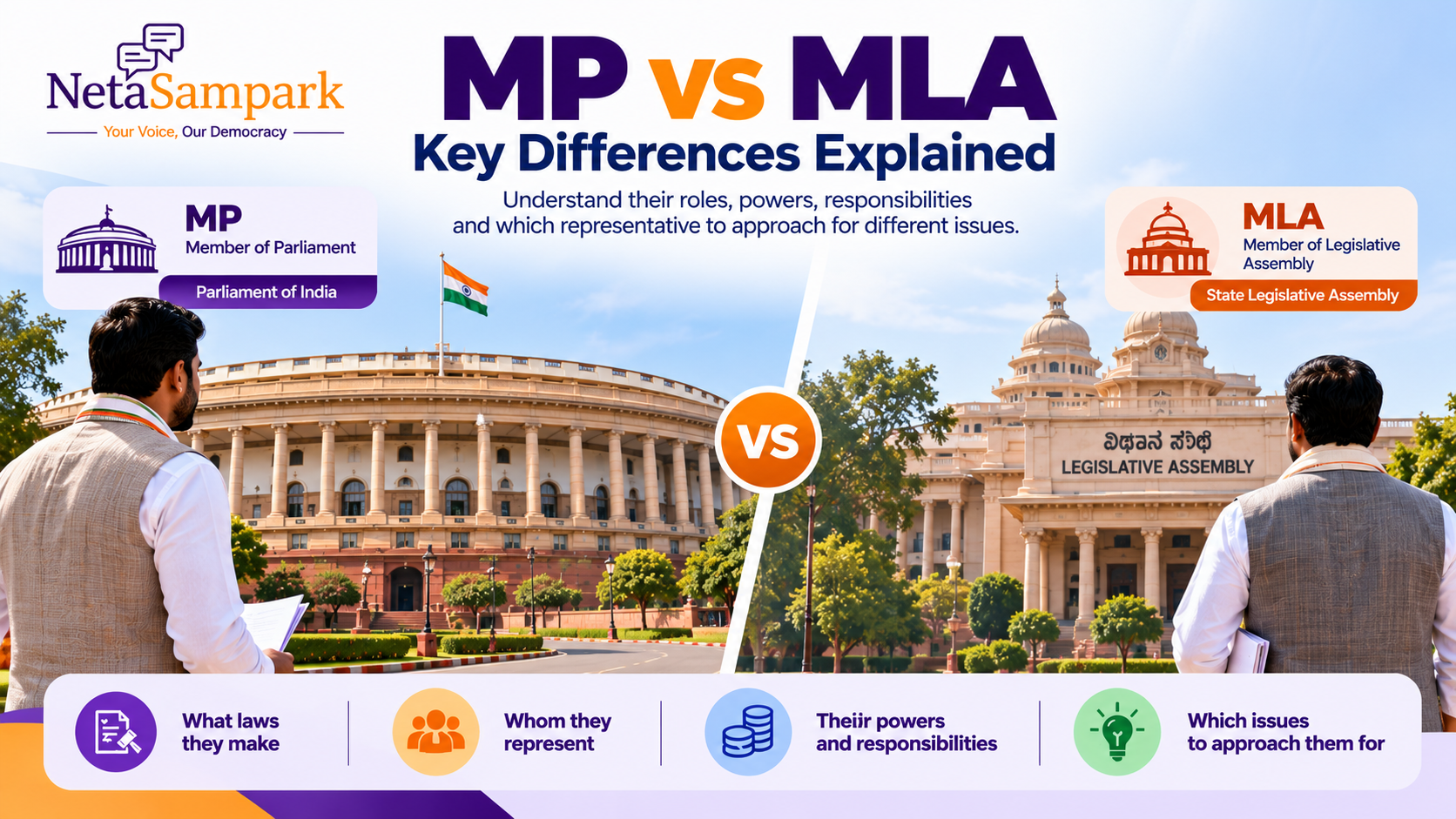
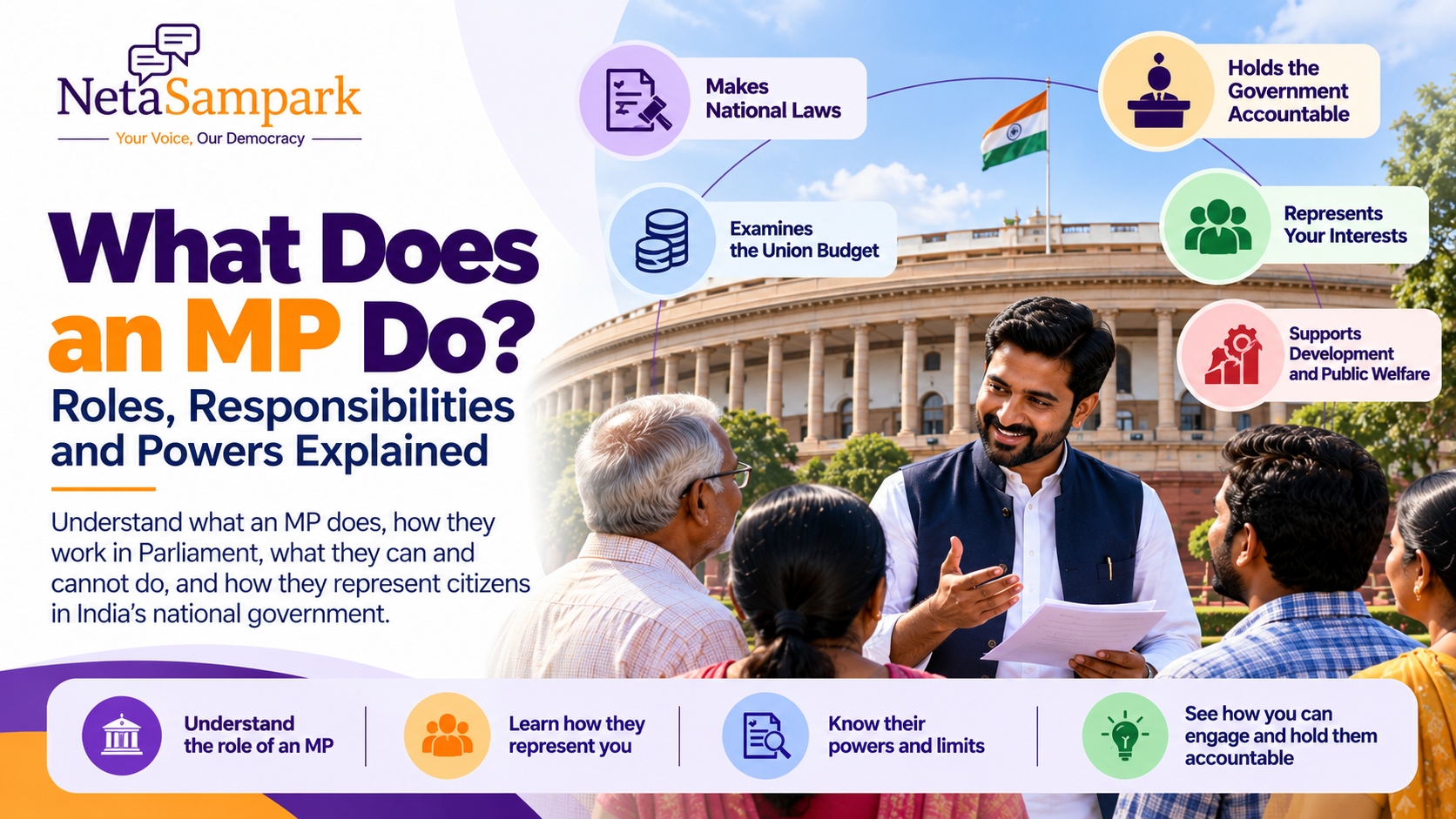
What does an MP do?
An MP represents a parliamentary constituency or, in the case of Rajya Sabha members, performs a representative role through the relevant state or national framework.
MPs participate in debates, vote on legislation, raise public issues and scrutinise the government. They may also advocate for local development needs, but an MP does not personally administer every public service or directly control all government departments.
For a detailed explanation, see the NetaSampark guide on the roles, responsibilities and powers of an MP.
5. How Does a Bill Become a Law in India?
A Bill is a proposal for a new law or a change to an existing law. Parliament follows constitutional and parliamentary procedures to consider Bills.
The general process for an ordinary Bill is as follows:
1. Drafting the Bill
A ministry, department or other authorised member develops a legislative proposal. Government Bills are generally prepared through the relevant ministry and legislative drafting process.
2. Introduction in Parliament
A Bill is introduced in either House, subject to applicable constitutional and procedural rules. Money Bills have special rules and can be introduced only in the Lok Sabha.
3. Discussion and examination
Members debate the proposal. Depending on the Bill and parliamentary decisions, it may be examined by a parliamentary committee.
4. Voting and passage
The House considers the Bill and votes on it. An ordinary Bill generally needs to pass both Houses in the same form.
5. Presidential assent
After passage by Parliament, the Bill is presented to the President. Once the required assent is given, it becomes an Act, subject to the applicable constitutional process.
6. Implementation
The responsible government authorities implement the Act. Where authorised, they may issue rules, regulations and notifications to operationalise its provisions.
The exact procedure varies according to the type of Bill. Money Bills, constitutional amendment Bills and certain other categories follow special constitutional requirements.
For official information, visit Digital Sansad's legislation section.
6. How Do State Governments Work in India?
India has a federal structure in which the Union and state governments exercise powers allocated by the Constitution.
Each state has its own constitutional institutions and administrative machinery. State governments handle matters such as public order, police, public health and agriculture within their constitutional responsibilities, while other subjects are shared or assigned differently.
Governor
The Governor is the constitutional head of a state. The Governor appoints the Chief Minister and performs other constitutional functions.
In the normal operation of the parliamentary system at state level, the Governor acts on the aid and advice of the Council of Ministers headed by the Chief Minister, except where the Constitution provides otherwise.
Chief Minister
The Chief Minister heads the elected state government and leads the Council of Ministers.
Responsibilities generally include:
- Setting state government priorities.
- Coordinating ministers and departments.
- Leading the state government's policy decisions.
- Overseeing implementation through the state administration.
- Working with the Union government and local authorities on matters requiring coordination.
State Legislative Assembly
The Legislative Assembly, or Vidhan Sabha, is the directly elected House of a state's legislature.
Its members are called Members of the Legislative Assembly (MLAs). The Assembly makes state laws within its constitutional authority, debates state issues, approves state expenditure and holds the state government accountable.
Some states also have a Legislative Council, or Vidhan Parishad, as a second legislative chamber.
What does an MLA do?
An MLA represents an Assembly constituency. MLAs participate in state lawmaking, raise local concerns in the legislature and scrutinise state government policies.
An MLA may advocate for better roads, schools, hospitals, water supply or other public services. However, responsibility for solving a particular issue depends on which department, agency or level of government has jurisdiction.
For more detail, see the NetaSampark guide explaining the roles, responsibilities and powers of an MLA.
7. What Is the Difference Between the Union Government and State Governments?
The Constitution distributes legislative powers between the Union and states through the Union List, State List and Concurrent List in the Seventh Schedule.
Area Union government State governments
Defence Primary responsibility No equivalent general responsibility
Foreign affairs Primary responsibility Limited roles in relevant coordination
Currency Primary responsibility No independent currency authority
Police and public order Specific Union powers and responsibilities may apply Generally state responsibilities
Public health National policy and specified responsibilities Major state responsibilities
Agriculture Specific Union powers and national programmes Major state responsibilities
Education Union and state roles Union and state roles
Roads and transport National highways and other Union responsibilities State roads and transport responsibilities, as allocated by law
Taxation Taxes assigned to the Union Taxes assigned to states, with shared arrangements such as GST
These examples are broad rather than exhaustive. The precise division depends on constitutional entries and the applicable legislation. Both levels can legislate on Concurrent List subjects, and constitutional rules determine how conflicting laws are handled.
What is the Concurrent List?
The Concurrent List covers subjects on which both Parliament and state legislatures can make laws, subject to constitutional rules.
Education, forests, marriage and certain aspects of criminal law are examples of subjects that fall within the Concurrent List.
This arrangement allows national legislation and state-level governance to operate within a shared constitutional framework.
8. What Is Local Government in India?
Local government brings administration closer to citizens. Local bodies address community-level services and development, with their exact responsibilities depending on constitutional provisions, state laws and the powers devolved to them.
India has two broad types of local government.
Rural local government: Panchayati Raj
Panchayati Raj institutions govern rural local areas.
Their structure commonly includes:
- Gram Panchayat: Local government at village level.
- Panchayat Samiti or equivalent: An intermediate-level institution where applicable.
- Zilla Parishad or equivalent: District-level rural local government.
The names and structure of intermediate and district bodies vary by state.
Gram Panchayats may handle responsibilities such as local sanitation, village infrastructure, water-related services and development activities, depending on state law and devolved powers.
Urban local government
Urban local bodies govern towns and cities. Common forms include:
- Municipal Corporations.
- Municipal Councils.
- Nagar Panchayats.
Their functions may include local roads, drainage, waste management, public sanitation, street lighting and other civic services.
The 73rd and 74th Constitutional Amendments established important constitutional frameworks for rural and urban local self-government respectively. The actual division of responsibilities depends on state legislation and administrative arrangements.
Who should you contact for a local problem?
The appropriate authority depends on the issue and location.
Problem Possible first point of contact
Garbage collection or street cleaning Ward office or municipal authority
Damaged local road Municipal body, Panchayat or the department responsible for that road
Village water supply Gram Panchayat or relevant water-supply department
State government school issue School administration or the relevant education department
Public hospital service issue Hospital administration or health department
Police complaint Local police station or appropriate police authority
National highway issue Relevant national highway authority or responsible road agency
An elected representative can help raise an issue with the responsible authority, but the department with legal and administrative jurisdiction generally has to process and resolve it.
9. How Does the Judiciary Keep the Government Accountable?
India has an independent judiciary that interprets laws, resolves disputes and safeguards constitutional rights.
The main levels of the judicial system are:
- Supreme Court of India: The country's highest court.
- High Courts: The principal constitutional courts for states and certain Union Territories.
- Subordinate courts: Courts operating at district and other lower levels under the relevant judicial framework.
The judiciary performs several important functions.
Judicial review
Courts can examine whether legislation or government action complies with the Constitution. A law or action that violates constitutional requirements may be declared invalid to the extent of the violation.
Protection of Fundamental Rights
People can approach the courts through the constitutional remedies available to challenge violations of Fundamental Rights.
Resolution of disputes
Courts decide civil and criminal cases, constitutional disputes and other matters within their jurisdiction.
Independence of the judiciary
Judicial independence helps ensure that legal disputes are decided according to the law and Constitution rather than improper political or administrative pressure.
The Supreme Court describes constitutional supremacy, judicial independence and the division of government powers as key features of India's constitutional system.
10. How Are Elections Connected to the Indian Government?
Elections allow citizens to choose representatives who exercise public authority within the constitutional system.
The Election Commission of India (ECI) administers elections to Parliament, state legislatures and the offices of the President and Vice-President. State Election Commissions have constitutional responsibilities for elections to Panchayats and municipalities.
The electoral process connects citizens to different levels of government.
Citizens vote
Eligible voters choose candidates in elections for the relevant level of government.
Representatives take office
Elected MPs and MLAs participate in Parliament or state legislatures. Local representatives serve in Panchayats and municipalities.
Governments make decisions
Governments develop policies, propose legislation and administer public programmes within their authority.
Citizens hold institutions accountable
People can raise issues, seek information, participate in consultations and assess representatives' work.
Elections are central to representative democracy, but accountability also operates between elections through legislative scrutiny, public records, grievance mechanisms, courts, media and citizen participation.
To learn more about voter registration, read NetaSampark's guide on how to register as a new voter in India.
11. How Does the Government Spend Public Money?
Governments need public funds to deliver services, maintain infrastructure, run institutions and implement welfare programmes.
Public revenue comes from sources such as taxes, fees, duties, borrowing and other receipts authorised by law.
At the Union and state levels, the budget sets out estimated receipts and expenditure. Legislative approval is required for government spending through the applicable constitutional and financial procedures.
A simplified view of public spending looks like this:
1. Revenue is collected: Governments receive money through taxes and other authorised sources.
2. A budget is prepared: The government estimates income and proposes spending priorities.
3. The legislature considers the budget: Elected representatives debate and approve expenditure through the relevant procedures.
4. Departments implement programmes: Funds are allocated and spent under applicable laws, rules and approvals.
5. Spending is audited and scrutinised: Financial records are subject to audit and other accountability mechanisms.
The Union and state governments have separate budgets and financial responsibilities. Some programmes involve shared funding or implementation across multiple levels of government.
For example, a centrally sponsored programme may involve the Union government providing part of the funding while the state government and its departments manage implementation. The exact arrangement varies by scheme.
12. How Can Citizens Participate in the Indian Government?
Democracy is not limited to voting. Citizens can participate in governance in several ways.
Vote in elections
Check your electoral-roll entry, understand the candidates and exercise your voting rights when eligible.
Contact elected representatives
Citizens can contact their MP, MLA, councillor or Panchayat representative to raise public issues and request information or assistance.
Submit grievances
Use the grievance channel of the department responsible for the issue. For eligible Union government grievances, citizens can consult the Centralised Public Grievance Redress and Monitoring System (CPGRAMS). State and local authorities may have separate grievance systems.
Use the Right to Information
The Right to Information framework allows citizens to seek information from public authorities, subject to the law's provisions and exemptions. Information requests can help people understand decisions, expenditure and administrative processes.
Participate in local governance
Citizens can attend relevant public meetings, participate in Gram Sabhas where applicable, provide feedback during consultations and engage with local civic bodies.
Track government performance
Review official announcements, budgets, public records, legislative proceedings and programme information rather than relying solely on social media claims.
Raise issues peacefully and lawfully
Petitions, public consultations, lawful demonstrations, community initiatives and citizen groups are among the ways people can advocate for change.
The effectiveness of citizen participation improves when people identify the responsible authority, document the issue clearly and use the appropriate channel.
13. Common Misconceptions About the Indian Government
Misconception What is correct?
The President runs the government alone. The President is the constitutional head of the Union. The Prime Minister and Council of Ministers lead the elected government's day-to-day functioning within the constitutional framework.
Parliament controls every state subject. Legislative powers are divided between the Union and states by the Constitution.
MPs and MLAs directly operate every public service. Representatives legislate, scrutinise and raise issues. Departments and public authorities usually administer services.
Every government decision is made by the Prime Minister. Decisions are made through constitutional institutions, ministries, departments, legislatures and other authorised bodies.
Courts can only hear criminal cases. Courts also handle civil, constitutional, administrative and other disputes within their jurisdiction.
Voting is the only way to participate in democracy. Citizens can also submit grievances, seek information, participate in consultations and engage with representatives.
All public services are controlled by the Union government. Services and responsibilities are distributed among Union, state and local institutions.
14. Frequently Asked Questions About How the Indian Government Works
How does the Indian government work in simple words?
India's government works through constitutional institutions at Union, state and local levels. Legislatures make laws and scrutinise governments, executives implement laws and policies, and courts interpret laws and protect constitutional rights. Elections allow citizens to choose representatives.
Who is the head of the Indian government?
The Prime Minister heads the Union government's political and administrative functioning. The President is the constitutional head of state. These are different roles within India's parliamentary system.
What are the three organs of the Indian government?
The three principal organs are the legislature, executive and judiciary. They perform lawmaking, administration and judicial functions respectively.
What is the difference between Parliament and the government?
Parliament is the Union's legislative institution, consisting of the President, Lok Sabha and Rajya Sabha. The Union government is led by the Prime Minister and Council of Ministers, who exercise executive authority and are collectively responsible to the Lok Sabha.
What is the difference between the Union government and state government?
The Union government handles matters assigned to it by the Constitution, including defence and foreign affairs. State governments handle matters within state jurisdiction, such as public order and police, subject to constitutional provisions. Some subjects are shared.
Who makes laws in India?
Parliament makes laws on subjects within Union and other applicable constitutional powers. State legislatures make laws within their constitutional authority. Local bodies can make certain rules and by-laws where authorised by legislation.
Who implements laws in India?
The executive implements laws through ministries, departments, civil servants, police and other authorised agencies. Implementation may involve Union, state and local authorities depending on the subject.
Can the courts challenge government decisions?
Yes. Courts can review government actions and legislation for compliance with the Constitution and applicable law. They can grant appropriate remedies within their jurisdiction.
What role do MPs and MLAs play in government?
MPs participate in Parliament, national lawmaking and scrutiny of the Union government. MLAs participate in state legislatures, state lawmaking and scrutiny of state governments. Both can raise constituency concerns, but administrative responsibility depends on the issue.
How can I find out which government department is responsible for my problem?
Identify whether the issue concerns a Union, state or local responsibility, then consult the relevant official department or grievance portal. The Government of India directory can help locate official institutions and websites.
Conclusion: Understanding Government Helps Citizens Participate Better
The Indian government is a constitutional system in which authority is distributed among institutions and across different levels of administration. Parliament and state legislatures make laws and scrutinise governments, the executive implements policies and delivers services, and the judiciary interprets laws and protects constitutional rights.
The Union government, state governments and local bodies each have important responsibilities. Knowing which institution handles a particular issue helps citizens approach the right authority, ask better questions and participate more effectively in democracy.
Understanding how government works is the first step towards holding institutions accountable and making informed civic decisions.
Explore more civic guides on NetaSampark to understand elected representatives, voter services, public institutions and your rights as a citizen.
Official Sources and Further Reading
- Constitution of India — Supreme Court of India
- About Parliament — Digital Sansad
- How a Bill Becomes an Act — Digital Sansad
- Government of India official directory
- Article 246 and legislative powers — Ministry of Education
- Election Commission of India
- Centralised Public Grievance Redress and Monitoring System