MP vs MLA: Key Differences, Roles and Powers
Introduction
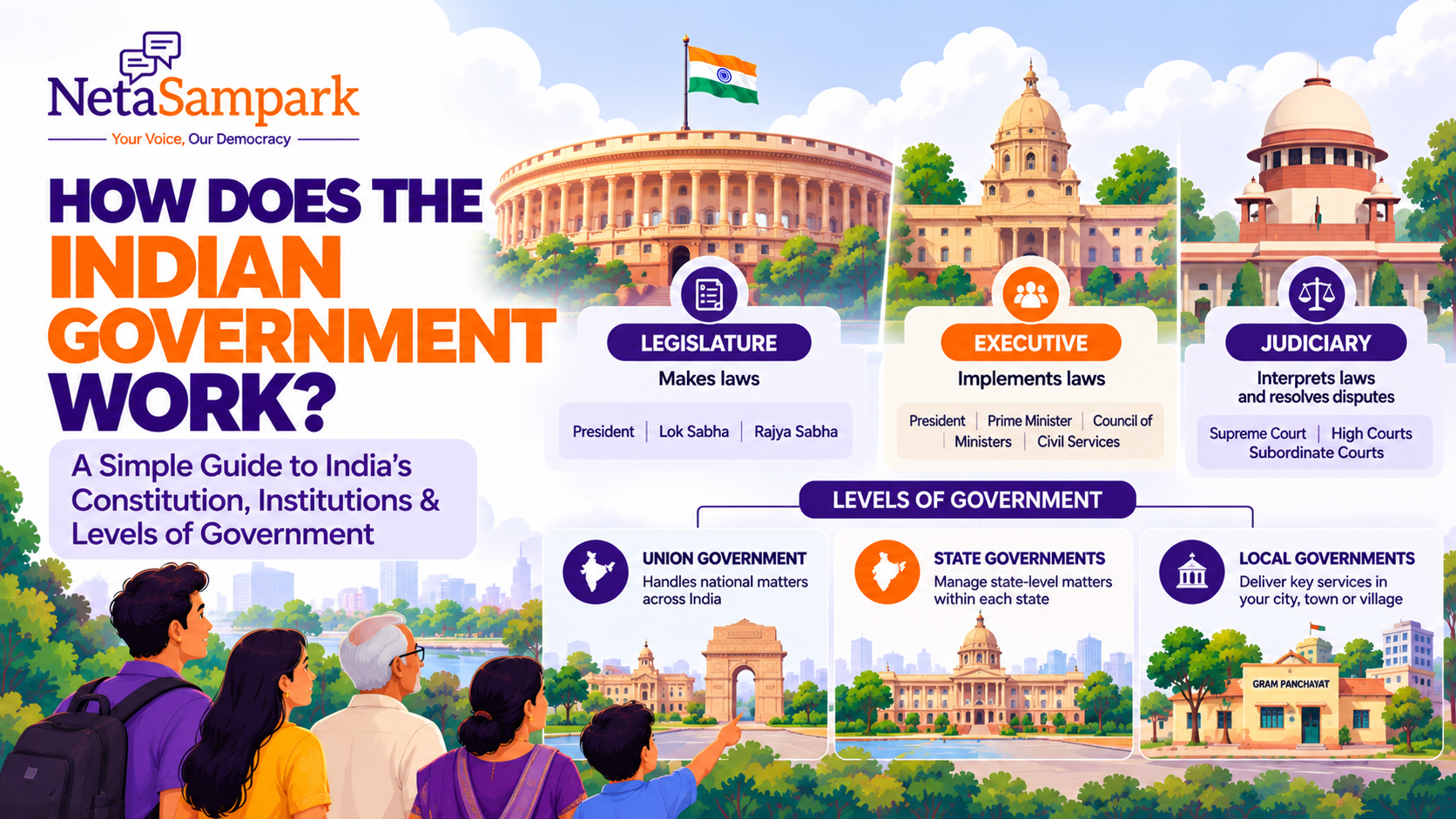
India has different levels of government, each responsible for different aspects of public administration. Two important representatives citizens encounter are the Member of Parliament (MP) and the Member of the Legislative Assembly (MLA).
Both participate in lawmaking, raise public concerns and hold governments accountable. However, they work in different legislatures, deal with different areas of governance and have different responsibilities.
Understanding the difference between an MP and an MLA can help you decide whom to approach when you face a public issue, want to raise a grievance or seek information about government policies.
What is the difference between an MP and an MLA?
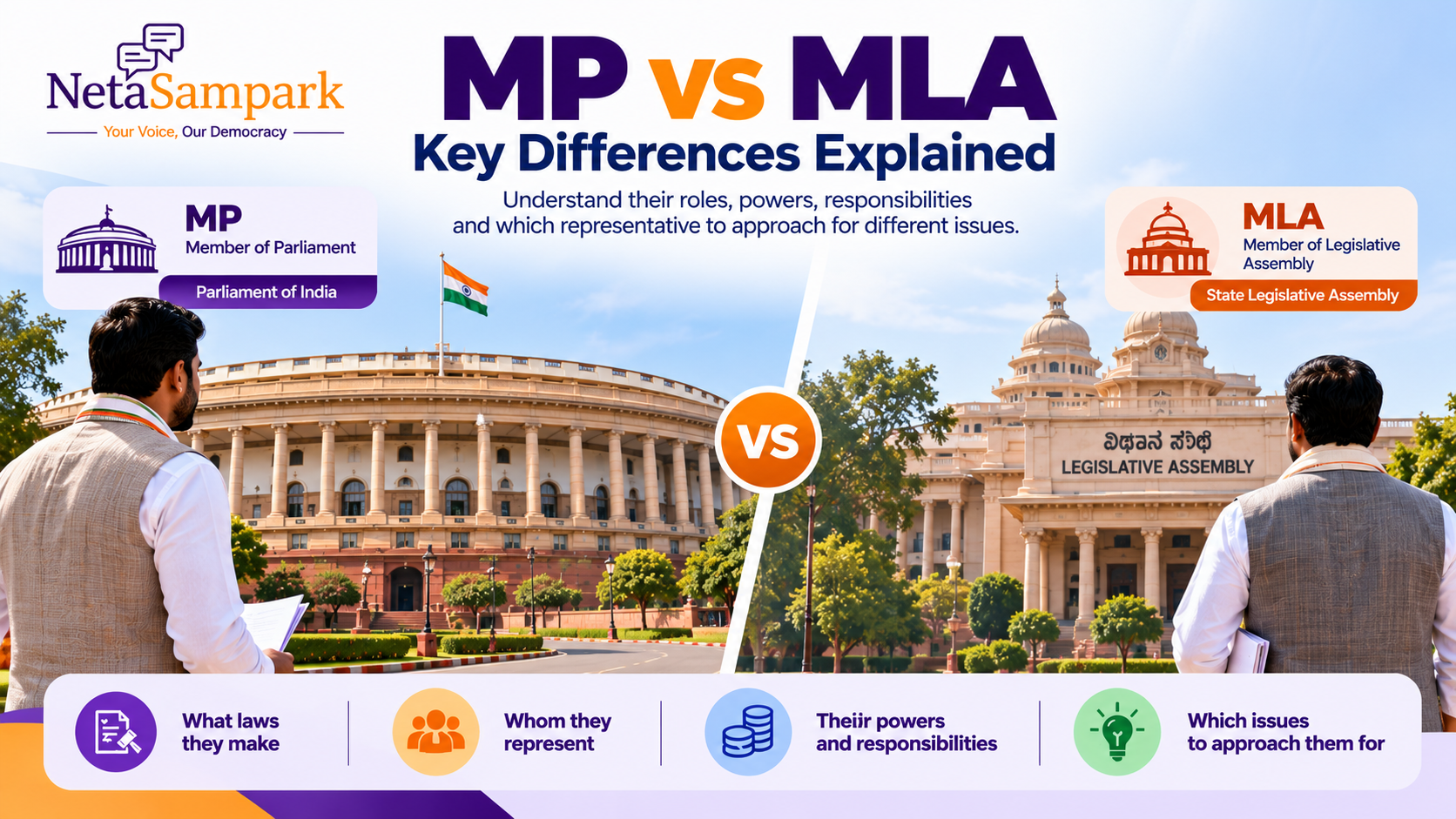
An MP (Member of Parliament) serves in the Parliament of India, which deals primarily with national legislation and the Union Government.
An MLA (Member of the Legislative Assembly) serves in a state's Legislative Assembly, which deals with state legislation and the State Government.
In simple terms, an MP works at the national legislative level, while an MLA works at the state legislative level. Their exact responsibilities depend on the Constitution, applicable laws and the subject involved.
MP vs MLA: Comparison at a glance
Feature MP — Member of Parliament MLA — Member of Legislative Assembly
Level of government National / Union State
Legislative body Parliament of India State Legislative Assembly
Constituency Lok Sabha MPs represent parliamentary constituencies; Rajya Sabha MPs represent states or Union Territories Represents an Assembly constituency
Main legislative focus National laws and Union subjects State laws and state subjects
Government oversight Holds the Union Government accountable Holds the State Government accountable
Budget Examines the Union Budget Examines the State Budget
Direct election Lok Sabha MPs are directly elected; Rajya Sabha MPs are generally elected indirectly MLAs are directly elected by voters
Usual term Lok Sabha: 5 years, unless dissolved earlier; Rajya Sabha: 6 years Normally 5 years, unless dissolved earlier
Minimum age 25 for Lok Sabha; 30 for Rajya Sabha 25
Executive leadership An MP may become Prime Minister or a Union Minister, subject to constitutional requirements An MLA may become Chief Minister or a State Minister, subject to constitutional requirements
Note: This comparison focuses on MPs and MLAs in the usual state-level system. Constitutional provisions and special arrangements can create exceptions.
1. What does an MP do?
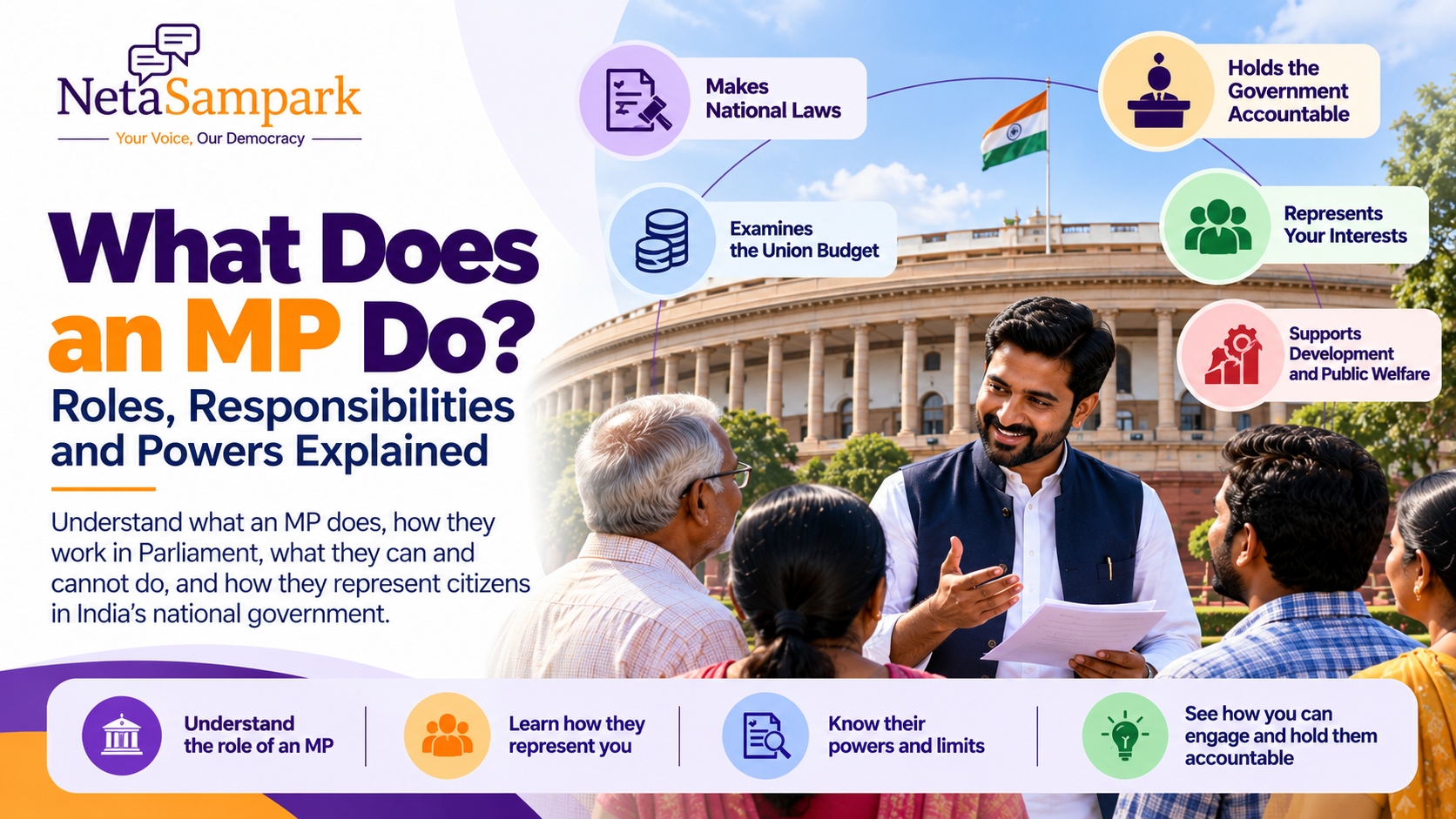
An MP participates in national policymaking and the functioning of Parliament. MPs contribute to legislation, scrutinise the Union Government and represent public concerns at the national level.
Their responsibilities include:
* Making national laws: Debating and voting on Bills within Parliament's legislative competence.
* Holding the Union Government accountable: Asking questions, participating in debates and scrutinising government decisions.
* Examining public spending: Discussing the Union Budget and examining expenditure through parliamentary processes and committees.
* Representing citizens: Raising constituency concerns and bringing public issues to the attention of the Union Government.
* Supporting development: Advocating for infrastructure, public services and eligible local development works through appropriate channels.
MPs do not personally administer every government department or directly control all public services in their constituencies. Their influence depends on their legislative role, the issue involved and the relevant authorities.
Read our full guide: What Does an MP Do? Roles, Responsibilities and Powers Explained.
2. What does an MLA do?
An MLA participates in the State Legislative Assembly and represents the people of an Assembly constituency.
MLAs focus on state legislation, state-level policy and oversight of the State Government.
Their responsibilities include:
* Making state laws: Debating and voting on Bills concerning subjects within the state's legislative powers.
* Holding the State Government accountable: Asking questions, participating in debates and examining the work of state departments.
* Examining the State Budget: Discussing government expenditure, taxation and allocation of state funds through the legislative process.
* Representing constituents: Raising concerns about public services, infrastructure, welfare and other state-related issues.
* Advocating for development: Following up with relevant authorities on roads, water supply, schools, hospitals and other public needs, depending on who is responsible.
An MLA cannot independently order every department to take action or guarantee that a particular project will be approved. Implementation depends on applicable rules, budgets and the authorities responsible.
Read our full guide: What Does an MLA Do? Roles, Responsibilities and Powers Explained.
3. Who makes which laws?
One of the most important differences between an MP and an MLA is their legislative jurisdiction.
The Constitution of India distributes legislative subjects between Parliament and state legislatures through the Union List, State List and Concurrent List. <sup>1</sup>
Parliament legislates on Union List subjects, such as defence and foreign affairs. State legislatures legislate on State List subjects, such as public order, police and public health, subject to constitutional provisions. Both Parliament and state legislatures can legislate on Concurrent List subjects, such as education and forests, with constitutional rules governing conflicts between laws.
For example:
* National defence policy is primarily a Union matter.
* State police administration falls primarily within the state sphere.
* Education involves both Union and state legislation.
This division is not absolute in every circumstance. The Constitution provides exceptions and special circumstances in which Parliament may legislate on State List matters.
4. Who should you contact for different problems?
The right representative depends on the nature of the issue, the authority responsible for it and the action required.
Public issue A useful first point of contact
State policy or a state department's decision MLA or the relevant state department
A national policy or Union Government department MP or the relevant Union department
A local road, drainage or streetlight problem Municipal corporation, municipality or panchayat
A state-run school or hospital issue Relevant institution or state department; escalate to the MLA if necessary
Railway service or a Union Government service issue Relevant service authority; an MP may help escalate unresolved concerns
A grievance about a central government scheme Relevant scheme authority or Union department; an MP may help raise the issue
A state-level welfare scheme issue Relevant state department or local implementing authority; an MLA may help escalate it
Important: An MLA or MP may help raise, refer or follow up on an issue, but the representative may not be the authority that can directly resolve it.
For local civic services, contacting the responsible municipal or panchayat office is often the most direct route. If the issue remains unresolved, you can escalate it through your elected representatives.
5. Does an MP have more power than an MLA?
Neither role is universally more powerful. Their authority depends on the subject and the constitutional responsibilities assigned to their respective legislatures.
An MP can influence national laws, Union policies and parliamentary scrutiny. An MLA can influence state laws, state policies and the scrutiny of state departments.
For example, an MP may raise concerns about a national railway policy, while an MLA may raise concerns about a state health programme. Neither can automatically exercise the other's powers simply because of their position.
The distinction is about jurisdiction and responsibility, not just seniority or political influence.
6. Can an MP and an MLA work together?
Yes. Many public issues require coordination between different levels of government.
Consider a road project connecting several towns. Depending on the road's classification and ownership, the responsibility may lie with a municipal body, a state department or a Union authority.
An MLA may raise concerns with the State Government, while an MP may raise matters involving a national highway authority or another Union agency. Local bodies and implementing departments may still be responsible for execution.
Similarly, a public health issue may require state-level administration, local implementation and support through national programmes.
The key is to identify the responsible department and involve the appropriate representative rather than assuming one elected official controls the entire process.
7. How can citizens hold MPs and MLAs accountable?
Citizens can evaluate representatives on their performance, accessibility and follow-through, rather than relying only on public statements.
Practical steps include:
1. Know your representatives: Identify your Assembly constituency and parliamentary constituency.
2. Understand their responsibilities: Check whether the issue falls under the Union Government, State Government or local body.
3. Submit a clear grievance: Include the location, relevant documents, dates and action already taken.
4. Ask for follow-up: Request a reference number, department contact or update where applicable.
5. Track progress: Keep records of responses and escalate through the appropriate grievance mechanism if necessary.
6. Review legislative performance: Look at attendance, participation, questions, debates and other publicly available records, while considering the context behind the numbers.
A representative's performance cannot be judged solely by the number of projects announced or complaints received. Citizens should also consider legislative work, oversight, transparency and whether concerns are followed through appropriately.
Frequently asked questions
Is an MP the same as an MLA?
No. An MP serves in Parliament at the national level, while an MLA serves in a State Legislative Assembly. Their legislative responsibilities and areas of government oversight differ.
Who is elected directly by the people: an MP or an MLA?
Both Lok Sabha MPs and MLAs are directly elected by voters from their respective constituencies. Rajya Sabha MPs are generally elected indirectly by elected members of State Legislative Assemblies, with some members nominated by the President.
Can an MLA solve a problem related to the Central Government?
An MLA may raise the issue, refer it to the appropriate authority or help a citizen seek a response. However, the MLA does not automatically have authority over Union Government departments.
Can an MP solve local problems such as roads and drainage?
An MP may help escalate local concerns, but the responsible municipal body, panchayat or government department usually handles implementation. The appropriate authority depends on the asset and service involved.
Can an MLA become an MP?
Yes. A person who meets the legal and constitutional requirements can contest a parliamentary election. However, the Constitution restricts a person from simultaneously being a member of both Parliament and a state legislature; the applicable rules govern which seat must be vacated.
Who should I approach first, my MP or my MLA?
Start with the authority responsible for the issue. For state policy or state departments, your MLA may be a useful representative. For Union Government matters, your MP may be more relevant. For routine civic services, contact the responsible local body first.
Key takeaway
MPs and MLAs are both important to Indian democracy, but they work at different levels of government.
* MP: Represents a parliamentary constituency or state/Union Territory in Parliament and contributes to national lawmaking and oversight of the Union Government.
* MLA: Represents an Assembly constituency and contributes to state lawmaking and oversight of the State Government.
* Local authority: Often handles the day-to-day delivery of civic services such as drainage, streetlights and local roads.
Knowing who is responsible for what helps citizens raise concerns effectively, follow up with the right department and hold public representatives accountable.
Know your representatives. Understand their responsibilities. Make your voice count.
Explore more citizen guides on NetaSampark to learn how India's government works and how you can participate in democracy.
Official and reference resources
1. Constitution of India — Legislative Department: https://legislative.gov.in/
2. Supreme Court of India — Constitution and legislative powers: https://www.sci.gov.in/constitution/
3. PRS Legislative Research — Parliamentary and legislative analysis: https://prsindia.org/
4. Lok Sabha: https://loksabha.nic.in/
5. Rajya Sabha: https://rajyasabha.nic.in/
This guide is for general civic education. The Constitution, applicable laws and official government procedures determine the precise powers and responsibilities of each institution.