What Does an MLA Do? Roles, Responsibilities and Powers Explained
An MLA, or Member of the Legislative Assembly, is an elected representative who represents people from an Assembly constituency in a state or Union Territory legislature. MLAs help make state laws, scrutinise government spending, question the government and raise issues affecting their constituents.
But an MLA's role goes beyond the Legislative Assembly. Citizens also approach MLAs for help with local infrastructure, public services, government schemes and administrative problems.
Understanding what an MLA can and cannot do helps citizens raise issues with the right authority and hold their representatives accountable.
1. What Is an MLA?
MLA stands for Member of the Legislative Assembly.
An MLA is elected by voters from an Assembly constituency to represent them in the state legislature. The number of constituencies and the boundaries of each constituency are determined under the applicable electoral framework.
For example, a person elected from an Assembly constituency in Karnataka becomes an MLA representing that constituency.
MLAs may belong to a political party or contest as independent candidates. Once elected, their responsibilities include participating in legislative proceedings and representing the concerns of their constituents.
In simple terms: An MLA represents a constituency in the state legislature and helps shape state policies, laws and government accountability.
2. What Are the Main Responsibilities of an MLA?
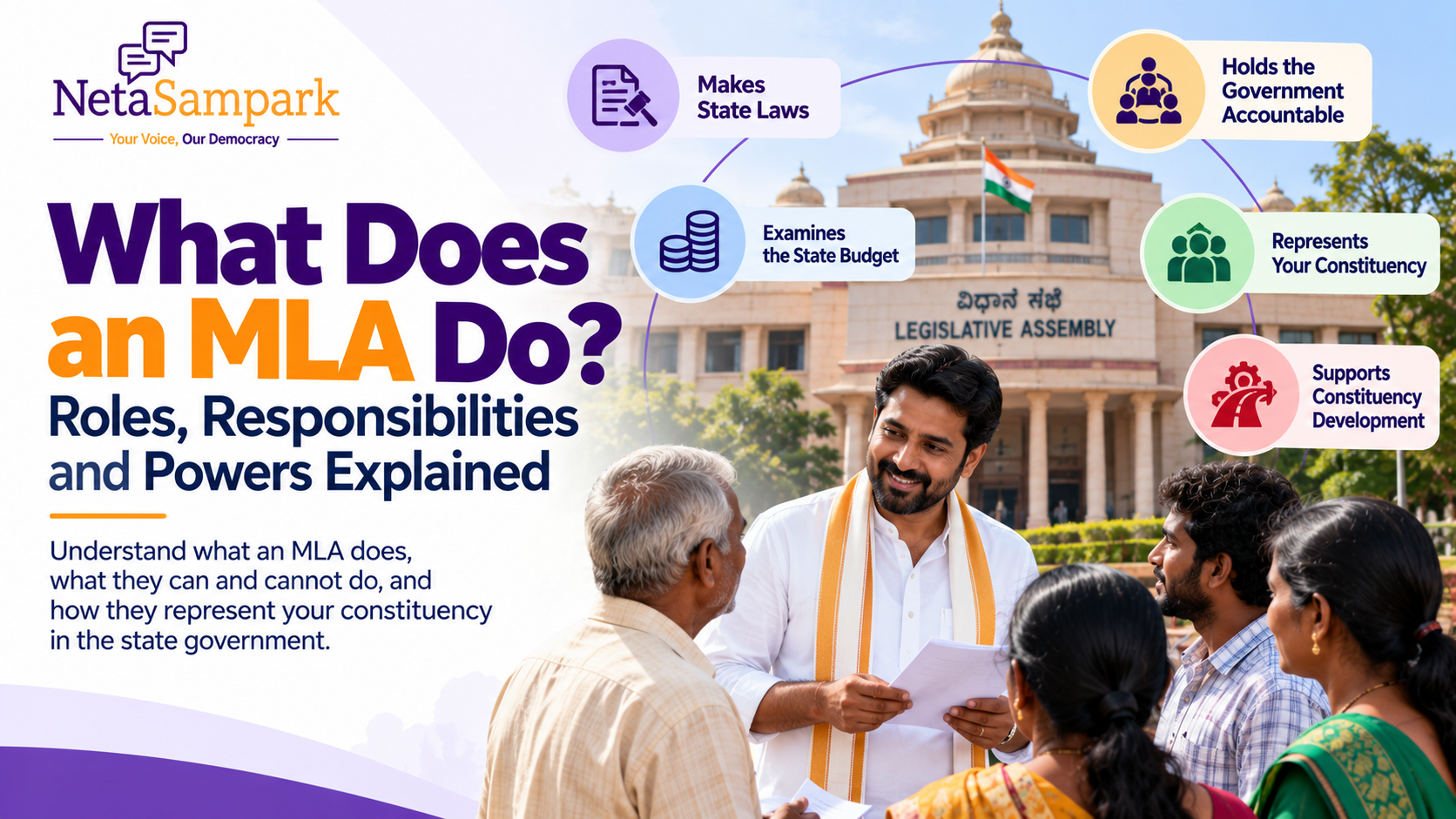
An MLA has several important responsibilities. These can be grouped into five broad areas.
A. Making and debating state laws
One of the primary responsibilities of an MLA is to participate in the legislative process.
MLAs can:
* Participate in debates on proposed laws.
* Examine Bills introduced in the Assembly.
* Propose amendments where permitted by legislative procedure.
* Vote on Bills and other matters before the House.
* Participate in legislative committees when appointed.
State legislatures make laws on subjects within their constitutional and legal competence. These include many areas of state administration, while some subjects are shared with Parliament and others fall under the Union's authority.
Example: If a state government proposes legislation relating to a matter within the state's legislative powers, MLAs can debate its provisions, raise concerns and vote on it.
B. Holding the state government accountable
MLAs play an important role in scrutinising the work of the state government.
They can use legislative procedures to:
* Ask questions to ministers.
* Seek explanations about government decisions.
* Raise issues concerning public services.
* Participate in debates and discussions.
* Examine departmental performance through legislative processes and committees.
These mechanisms help the legislature question how government departments operate and whether public concerns are being addressed.
Example: If a government hospital in a constituency lacks essential facilities, an MLA may raise the issue with the Health Department and, where appropriate, question the responsible minister in the Assembly.
C. Examining the state budget and public spending
The state budget determines how the government plans to raise revenue and spend public money.
MLAs participate in discussions and voting on government expenditure, including allocations for areas such as education, healthcare, agriculture, infrastructure and social welfare.
Their responsibilities can include:
* Examining budget proposals.
* Debating expenditure priorities.
* Questioning allocations and spending decisions.
* Participating in financial oversight through the legislature.
The exact procedures and opportunities for scrutiny vary across state legislatures.
Example: If a constituency needs better public healthcare facilities, an MLA can raise the need for funding and question the government about relevant allocations and implementation.
An MLA does not personally control the entire state budget or independently decide how every department spends its money.
D. Representing constituency issues
MLAs are an important point of contact between citizens and the state government.
They may raise concerns about:
* Roads and public infrastructure.
* Government schools and hospitals.
* Drinking water and sanitation.
* Agricultural issues.
* Public transport.
* Delays in eligible government benefits.
* Problems with local public services.
An MLA may communicate with the relevant department, request action, follow up on a complaint or raise the matter in the Assembly.
However, the department or public authority responsible for the issue generally remains responsible for investigating and implementing the solution.
E. Supporting constituency development
MLAs can help identify development priorities and advocate for projects that benefit their constituencies.
Depending on the state, applicable rules and available funding, this may involve:
* Recommending eligible development works.
* Raising infrastructure requirements with departments.
* Following up on sanctioned projects.
* Reviewing implementation progress.
* Coordinating with relevant public authorities.
The details of constituency development funds, project recommendations and approval powers differ between states.
Important: Public development funds are governed by official rules. They are not the MLA's personal money, and an MLA cannot automatically approve or execute every project requested by a citizen.
3. What Can an MLA Do for You?
If you are facing a problem in your area, your MLA may be able to help you reach the right authority or seek action.
Here are some common examples.
Your problem How an MLA may help
A damaged road Raise the issue with the responsible department and follow up on repairs.
Shortage of facilities in a government school Bring the issue to the Education Department and seek action or funding.
Problems at a government hospital Escalate the concern to the Health Department or responsible authority.
A drinking water shortage Request intervention from the relevant water supply authority.
A delayed eligible government benefit Help direct the grievance to the responsible department and seek a status update.
An incomplete development project Ask the responsible authority for progress details and raise delays.
A recurring problem affecting an entire neighbourhood Bring the issue to the relevant officials and, where appropriate, raise it through legislative channels.
The MLA's ability to resolve an issue depends on the subject, applicable law, available funds, the authority responsible and the facts of the case.
4. What Powers Does an MLA Have?
An MLA's powers come from the Constitution, applicable laws and the rules governing the legislature.
Broadly, these include:
Legislative powers: Participating in the making of state laws within the legislature's constitutional competence.
Financial powers: Participating in scrutiny and approval of state government expenditure through legislative procedures.
Oversight powers: Questioning ministers, debating government decisions and using available legislative mechanisms to scrutinise administration.
Representative responsibilities: Raising constituency concerns and advocating for public needs.
Committee responsibilities: Examining Bills, government programmes or public expenditure when assigned to relevant legislative committees.
An MLA's powers are exercised within a constitutional and legal framework. Being an elected representative does not place an MLA above the law or give them unrestricted authority over government departments.
5. What Can an MLA NOT Do?
Understanding the limits of an MLA's authority is just as important as understanding their responsibilities.
An MLA generally cannot:
* Personally guarantee a government job: Recruitment must follow the applicable recruitment rules and selection process.
* Order every government department to act outside the law: Departments must follow their legal powers, procedures and rules.
* Unilaterally approve every development project: Projects may require technical assessments, administrative approval, funding and other clearances.
* Personally sanction every government benefit: Eligibility and approval are determined by the applicable scheme and the authority responsible.
* Directly control every police or judicial decision: These matters are governed by the relevant laws, institutional responsibilities and procedures.
* Use public funds as personal money: Public expenditure must follow applicable financial rules and approvals.
An MLA may advocate for a citizen, raise a concern or seek an explanation. That is different from having the legal authority to make the final decision.
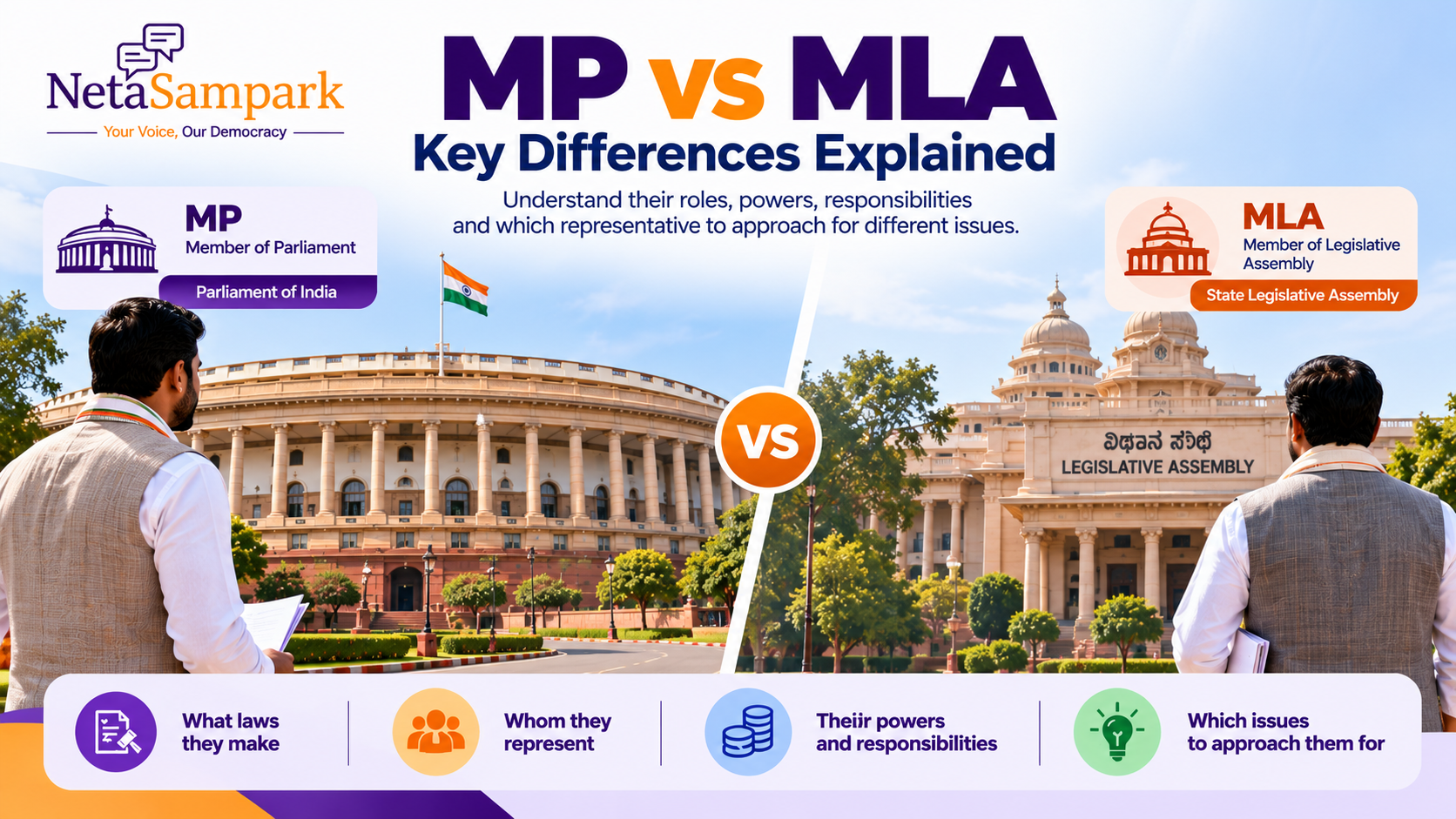
6. MLA vs MP: What Is the Difference?
An MLA and an MP are both elected representatives, but they serve different legislatures and have different primary responsibilities.
Feature MLA MP
Full form Member of the Legislative Assembly Member of Parliament
Represents An Assembly constituency A Parliamentary constituency in the Lok Sabha, or a state/Union Territory in the Rajya Sabha
Legislature State or relevant Union Territory Legislative Assembly Parliament of India
Main legislative role Participates in state-level lawmaking Participates in national lawmaking
Government oversight Scrutinises the state government Scrutinises the Union government, through the relevant parliamentary processes
Budget role Participates in state budget scrutiny and approval Lok Sabha members participate in the Union budget process; Rajya Sabha has constitutionally defined financial powers
Typical public concerns State services and constituency development National policy and matters within Union responsibility, alongside constituency concerns
Some subjects involve both Union and state responsibilities. The right representative or authority therefore depends on the specific issue.
7. When Should You Contact Your MLA?
Consider contacting your MLA when:
* A public service problem remains unresolved.
* An issue affects multiple residents or an entire neighbourhood.
* A government department has not responded adequately to a legitimate concern.
* A constituency needs public infrastructure or improved facilities.
* A local development project appears delayed.
* You want your concern raised with the responsible minister or department.
Before contacting your MLA, prepare a concise description of the problem. Include the location, relevant dates, photographs or supporting documents, any complaint reference number and the action you are requesting.
For routine matters, you may need to contact the responsible department or local authority directly first. Your MLA may be able to help escalate an unresolved issue, but contacting an MLA does not replace formal complaint or appeal procedures.
8. How Can You Hold Your MLA Accountable?
Citizens can evaluate their representatives by looking at their work, engagement and follow-through—not only their public statements.
Here are some practical steps:
1. Understand the role: Know which issues fall within the state legislature's responsibilities.
2. Raise specific concerns: Submit clear, evidence-based requests rather than vague complaints.
3. Keep records: Save complaint numbers, written responses and supporting documents.
4. Follow up: Ask for updates and the name of the department handling the matter.
5. Check progress: Where information is available, verify whether the issue was addressed or the project completed.
6. Participate in public life: Attend public meetings, engage with consultations and communicate with your elected representatives.
7. Use formal channels: Where necessary, approach the relevant grievance authority, information commission or other competent body.
Accountability is an ongoing process. One unresolved complaint does not, by itself, establish that an MLA has failed in all their responsibilities; equally, promises alone do not demonstrate that an issue has been resolved.
9. Frequently Asked Questions
- Does an MLA work only in the Legislative Assembly?
- No. An MLA's legislative duties take place in the Assembly and its committees, but constituency representation can also involve meeting citizens, raising public issues and following up with departments.
- Can an MLA solve a personal problem?
- An MLA may help direct a legitimate grievance to the right authority or seek an update. However, the outcome depends on the law, the facts and the authority responsible for the decision.
- Can an MLA provide government jobs?
- An MLA cannot lawfully bypass the applicable recruitment process. Government appointments must follow the relevant rules and selection procedures.
- Does an MLA have a development fund?
- Some states provide funds or schemes through which eligible constituency development works may be recommended or supported. The amount, permitted uses, approval process and implementing authorities depend on the state's rules.
- Who is responsible if a road in my area is damaged?
- It depends on which authority owns or maintains the road. Responsibility may lie with a municipal body, a state department, a development authority, a panchayat or another agency. An MLA may help raise the issue, but the responsible authority generally handles the repair.
- Can I complain against my MLA?
- Citizens can raise concerns through appropriate lawful channels, depending on the nature of the complaint. Allegations of misconduct, election-related violations or criminal conduct may fall under different authorities and procedures.
- How can I find my MLA?
- You can check your Assembly constituency using official election resources and consult your state Legislative Assembly's website for representative information. You can also use NetaSampark to explore representatives and constituency-related information.
10. Key Takeaways
* An MLA represents an Assembly constituency in the state legislature.
* The main responsibilities include lawmaking, government oversight, budget scrutiny and constituency representation.
* MLAs can raise public issues and advocate for development, but they do not personally control every department or public fund.
* The authority responsible for resolving a problem depends on the subject and applicable law.
* Citizens can contribute to better governance by raising specific concerns, tracking progress and following up through appropriate channels.
Find Your Representative on NetaSampark
Knowing who represents you is the first step towards participating in democracy.
Use NetaSampark to explore elected representatives, learn about your constituency and take a more informed role in civic life.
Find your representative on NetaSampark →
Note: Legislative procedures and constituency development arrangements can vary between states. Readers should consult the applicable state laws, Assembly rules and official departmental guidance for state-specific details.